

Are Heat Pumps Worth It in Massachusetts? The North Shore Math
Oil at $6 a gallon changes the math. What heat costs from a heat pump against oil, propane and gas, and the 2026 rebates by North Shore town.
Heating oil averaged $6.115 a gallon in Massachusetts in the week of October 19, 2026, about $2.57 more than a year earlier. If your last delivery made you wince, you are probably wondering whether a heat pump would finally pay off.
The short answer: for most homes heated with oil, propane or electric baseboard, yes, and at this autumn's oil prices the case is strong. For homes on natural gas it is closer to a tie on running cost, so the reasons to switch are different.
Below is the math in plain numbers, what installation costs and what comes back, and how your rebate depends on which North Shore town you live in.
The short version
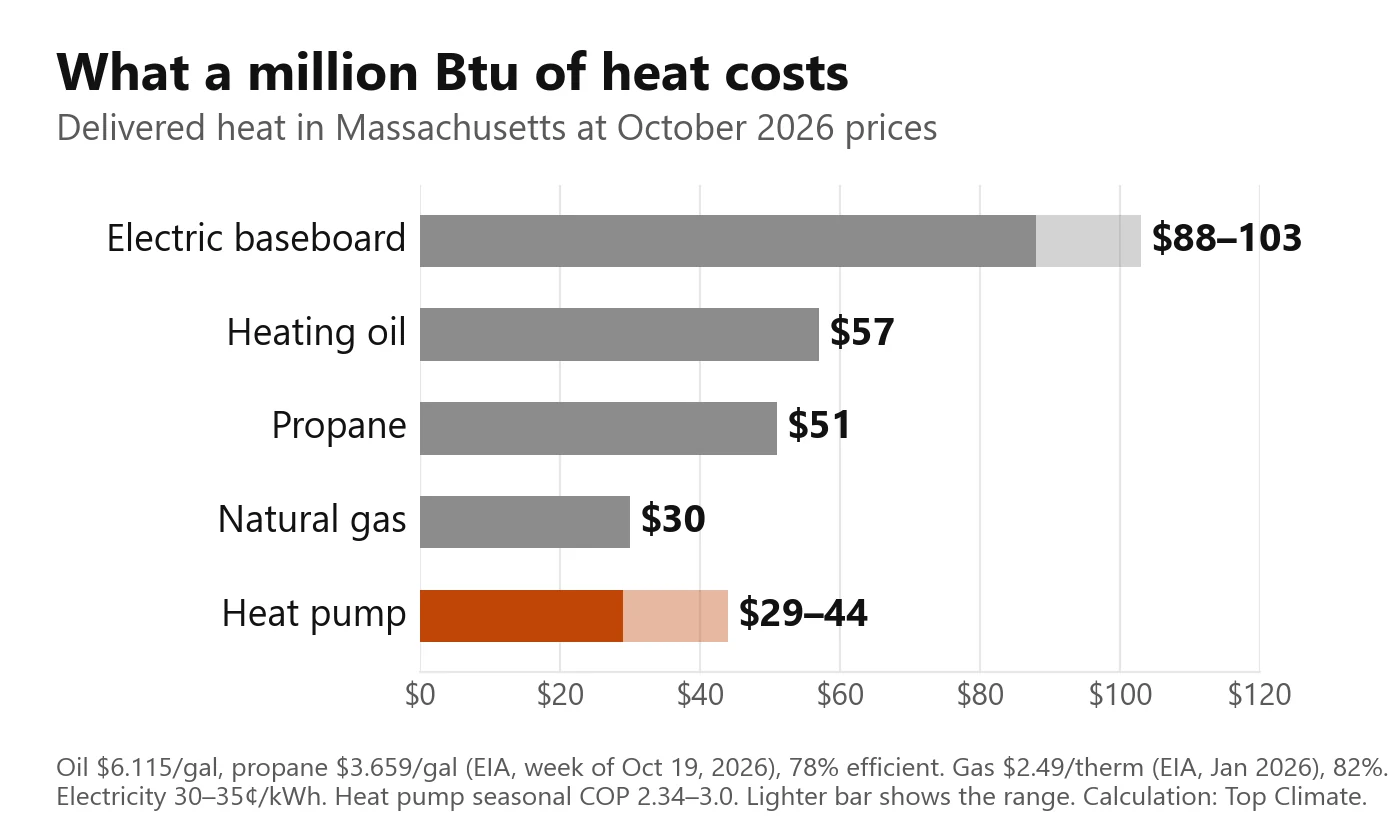
- At October 2026 prices, heat from oil costs about $57 per million Btu. A heat pump delivers it for about $29 to $44.
- Propane comes in around $51 and electric baseboard at $88 to $103, so both usually come out ahead with a heat pump.
- Natural gas costs about $30 for the same heat. A heat pump ties it at best, so gas homes switch for other reasons.
- Mass Save pays up to $8,500. Peabody, Marblehead, Danvers and Ipswich set their own rebates through their light plants.
- The federal heat pump tax credit ended for systems placed in service after December 31, 2025.
What does heat cost from each fuel this winter?
The fair way to compare fuels is the cost of one million Btu of heat actually delivered to your rooms, after the boiler, furnace or heat pump has done its work.
Using federal price data for Massachusetts, oil at $6.115 a gallon works out to about $57 per million Btu in an older system running at 78% efficiency. Propane at $3.659 a gallon comes to about $51. Natural gas, at about $2.49 a therm last January, comes to about $30 at 82% efficiency.
A heat pump paying 30 to 35 cents per kWh delivers the same heat for $29 to $44, depending on how efficiently it runs over the season. Electric baseboard turns each kWh into exactly one kWh of heat, so it costs $88 to $103.
Prices move, and oil moves weekly. Last winter the state's own comparison, made with oil forecast at $3.10 a gallon, put oil at $28.66 per million Btu and a heat pump at $29.37, almost level. This year's oil price is what tilted the math.
Is a heat pump worth it if you heat with oil or propane?
Most likely, yes. On the numbers above, a heat pump of average field efficiency paying 30 cents per kWh beats oil whenever oil costs more than about $4.06 a gallon. Today's price is about $2 above that.
Real homes back this up. A field study backed by the Massachusetts Clean Energy Center metered heat pumps in Massachusetts and New York homes. Whole-home systems in houses not heated by gas saved an estimated $682 a year on average, at fuel prices well below today's.
A 2025 analysis of Massachusetts homes found that under the heat pump electric rates, 73% of oil-heated homes and 93% of propane-heated homes would come out ahead. It used 2024 oil prices, not this year's.
Electric baseboard is the easiest case of all. A heat pump can deliver up to three times more heat than the electricity it uses, while baseboard delivers exactly as much.
What if you heat with natural gas?
Then be wary of any promise of savings. Gas costs about $30 per million Btu of heat, the bottom of the heat pump range. In the field study, gas homes that went whole-home with heat pumps paid an estimated $153 a year more, and the 2025 analysis found only half of gas homes would save, even on the heat pump rates.
Gas homes switch for other reasons. A heat pump also cools, so it can replace an aging central air conditioner and do both jobs with one system. If your AC is near the end of its life, that is the moment to price both options side by side.
How much does a heat pump cost to install?
It depends on the house more than anything. Green Energy Consumers Alliance, a Massachusetts nonprofit, puts whole-home systems at an average of $15,000 to $25,000, from about $6,000 for a small, well-insulated house to $45,000 for a large, under-insulated one.
Homes in the field study averaged $20,255 installed. Systems that heated part of the house with the old heat as backup cost less, and saved less: $461 a year against $682 for whole-home systems in non-gas homes.
There is no federal credit to subtract any more. The IRS says the heat pump tax credit is not allowed for any system placed in service after December 31, 2025.
Which rebate do you get on the North Shore?
It depends on who sends your electric bill. National Grid and Eversource customers get Mass Save rebates. In towns with their own light plant, the light plant sets the rebate. These are the 2026 programs.
Mass Save. Whole-home systems get $2,650 per ton, up to $8,500. Partial-home systems get $1,125 per ton, up to $8,500, plus $500 bonuses for weatherization and for sizing. The installer must be in the Mass Save Heat Pump Installer Network, the system installed by December 31, 2026, and the form postmarked by February 28, 2027.
Peabody and Marblehead. $500 per ton, up to 3 tons a year, so $1,500 at most. Apply by January 31, 2027.
Danvers. $1,500 per ton, up to $6,000, capped at half the project cost. Heat pumps that use R-410A refrigerant no longer qualify. Apply within 365 days of purchase or installation.
Ipswich. $500 per ton for partial-home systems, up to $2,000, and $750 per ton for whole-home systems, up to $3,000. An income-based adder raises the cap to $5,000. Cooling-only mini-splits do not qualify.
One exception: a light plant home that heats with natural gas from a Mass Save sponsor can still apply to Mass Save as a gas customer. Our own North Shore jobs include a two-zone Mitsubishi Hyper-Heat system in Ipswich and a ductless mini-split for a barbershop in Peabody, both light plant towns.
What else should go into the decision?
The winter heat pump rate. National Grid and Eversource customers with a heat pump pay lower delivery charges from November 1 to April 30, and regulators approved deeper National Grid discounts from November 1, 2026. Light plant customers are not eligible. Here is how the heat pump rate works and how to get it.
Cooling. A heat pump is also an air conditioner, so it can take over from a central AC that is due for replacement.
Lifespan. Plan on about 15 years for an air-source heat pump.
Cold weather. Efficiency falls on the coldest days, and the seasonal figures above already include them. Here is how mini-splits handle a Massachusetts winter.
Want the numbers for your own house? Heat pump installation
Frequently asked questions
Do heat pumps save money in Massachusetts?
For most homes heated with oil, propane or electric baseboard, yes. At October 2026 prices a heat pump delivers heat for about $29 to $44 per million Btu, against about $57 for oil and $51 for propane. For natural gas homes it is a tie at best, so savings are not guaranteed.
Is there still a federal tax credit for heat pumps?
No. The IRS says the energy efficient home improvement credit is not allowed for any property placed in service after December 31, 2025. Mass Save and light plant rebates still apply.
Can I keep my old heating system as a backup?
Yes. Many homes keep the old system for the coldest days, controlled so it only takes over below a set outdoor temperature. For a partial-home Mass Save rebate, those integrated controls must be set below Mass Save's maximum switchover temperature.
How long does a heat pump last?
About 15 years for an air-source heat pump. Regular heat pump maintenance keeps it running efficiently along the way.
Thinking about a heat pump this winter?
Top Climate installs Mitsubishi Electric, Daikin and Cooper&Hunter heat pumps across Salem and the North Shore. Estimates are free and on site.
Read more
 Heat Pump Not Heating or Blowing Cold Air? What to Check FirstHeat pump or mini-split blowing cool air this winter? See what normal defrost looks like, five checks to do yourself, and when to call a technician.
 Why Is My Electric Bill So High With a Heat Pump? (MA Checklist)A higher winter electric bill after a heat pump is partly normal. What is not, six checks you can do yourself, and how to get the Massachusetts heat pump rate.
 Do Mini-Splits Work in Cold Weather? A Massachusetts Winter GuideCan a mini-split heat a Massachusetts home in January? What a cold-climate rating means, how to size one for heat, and when to keep backup heat.